Many thanks to Simon Spillett to an entertaining session in which we covered:
“Pint of Bitter” by Clark Terry
“Off the Wagon” by Tubby Hayes
[Full report unavailable]
A place for keen local jazz musicians to meet in Cambridge

 Alec
Alec Many thanks to Simon Spillett to an entertaining session in which we covered:
“Pint of Bitter” by Clark Terry
“Off the Wagon” by Tubby Hayes
[Full report unavailable]
Many thanks to Mick Foster for an interesting session in which we covered
“The Saga of Harrison Crabfeathers” by Steve Kuhn
“Jumping at the Woodside” by Count Basie
The first part of the session was taken with an investigation of the Steve Kuhn composition “The Saga of Harrison Crabfeathers.” In this we were shown the various modes used in the piece. Mick kindly supplied some worksheets for further study here:
Chords and Modes used in Saga Of Harrison Crabfeathers Bb
Chords and Modes used in Saga Of Harrison Crabfeathers Eb
Chords and Modes used in Saga Of Harrison Crabfeathers
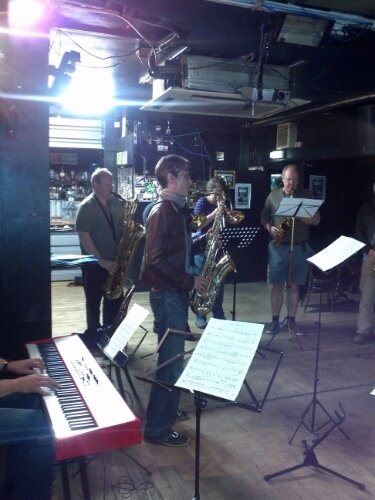
For the second part of the session, Mick whipped out his Bass Sax (if it’s possible to do so with such a beast) and took us through “Jumping at the Woodside” making us improvise rythmically with only restricted chord tones: Root and 5th, triads and then chord tones to the 7th. He pointed out how restricting to the chord tones can make the improvisations sound less modern.
![IMG_20140215_124732211[1]](http://www.cambridgejazzcoop.org.uk/wordpress/wp-content/uploads/2014/02/IMG_20140215_1247322111.jpg)
Many thanks again to Mick for coming to visit us.
After a brief residency at the Meadows Community Centre, we have returned to the location of the Man on the Moon pub, which is now under new management and is now the Blue Moon.
We shall be at the Blue Moon starting Saturday, 15th February 2014.
The location should be familiar to regular members of the jazz co-op, but see here for more details on how to find it.
The Cambridge Jazz Co-op has now moved from our old Man on the Moon venue to The Meadows Community Centre. Please ensure that you turn up at the correct location to avoid disappointment.
Many thanks to the incredible Carl Orr for hosting the last and packed to the rafters session before the summer break in which we covered:
“Easy to Love” by Victor Young
“Beauty and the Beast” by Wayne Shorter
Many thanks to the stellar Sheryl Bailey for some great tuition in this master class. To start the session, Sheryl performed a couple of numbers with Jon and Pete on drums and bass:
“Mr P.C.” by John Coltrane
“Blue Bossa” by Kenny Dorham
Mr P.C. Apologies for the quality of the video – I was finding a reasonable position for the camera at the time:
Blue Bossa – wow!:
In an interesting session Sheryl answered questions posed by Mickey which were along the lines of “what can we do to improve”. Some of her answers were: learn your inversions, learn your arpeggios and learn melodic embellishments. Here’s Sheryl talking about arpeggios:
And the use of melodic embellishments (enclosures):
The rest of the session was taken with Sheryl’s extension of the bebop scale called “Microcosmic Bebop Line”. Here is a clip where she demonstrates it and shows a couple of its applications:
Check out her Bebop flow lessons at Mike’s Master Classes for more on that and other topics. You might also want to checkout her Bebop Dojo: Essentials course at truefire.
We closed with a group performance of “On Green Dolphin Street”.
Many thanks to Sheryl for an inspiring session which along with the morning session should give us a few decades of work!
Many thanks to the amazing Sheryl Bailey for this week’s session in which we covered the following compositions:
“Sonnymoon for Two” by Sonny Rollins.
“All The Things You Are” by Jerome Kern.
The session started with a run through of “Sonnymoon for Two” with the co-op members taking a couple of choruses each. Here’s a clip towards the end with Derek’s solo on vibes (who knew? we thought he was merely a great drummer) followed by Sheryl closing the song:
During our solos Sheryl had been listening and picked up on some good playing especially by Giulio and Mickey and also spotted areas where there could be improvements (surely not!). Here are a few of her observations, hints and tips; plenty to consider:
After a short break, we turned to “All The Things You Are”. Here we are again, towards the end with Giulio on bass followed by Derek on vibes and then finally Sheryl closing it down:
Sheryl applied tritone subs at every point possible to give the following changes:

To get these changes consider a ii-V-I in C major
| Dm7 | G7 | CMaj7 | // |
We can apply a tritone Db7 substitution for the G7 to give
| Dm7 | Db7 | CMaj7 | // |
then whenever we see a ii chord we can add its related V and wherever we see a V chord we can add its related ii to convert them to a ii-V, giving the following:
| Dm7 G7 | Abm7 Db7 | CMaj7 | // |
Here’s Sheryl plugging a ii-V lick into the resulting changes:
If members of the Cambridge Jazz Co-op should take anything away from this session it would be the idea that “I don’t need to comp“:
Well, that was epic. Many thanks to Sheryl for coming to Cambridge and being so generous with her time and comments to the members of the Cambridge Jazz Co-op.
Many thanks to Pete Lemer for an interesting session in which we covered:
“Hadouk” by Didier Malherbe
“Nutsville” by Horace Silver
“Hadouk” was a slow composition with Middle Eastern flavour to it and had a slow melody played over a relatively simple arpeggiated background supplied by the guitars.
“Nutsville” was a much faster workout on the Horace Silver classic.
Thanks again to Pete for some nice tunes.

Many thanks to Adam for a great blowing session in which we played:
“Passion Fruit” by Ronnie Cuber
“Arroz con Pollo” by Ronnie Cuber
“Tones” by Adam Amor
The first part of the session saw the co-op members playing two originals by Ronnie Cuber, the great baritone saxophonist; “Passion Fruit” was described by Adam as “Summertime meets Work song” and is a brisk Latin number. “Arroz con Pollo” continued in a similar vein, it being a 12 bar composition with plenty of descending ii-Vs in the middle eight bars.
The afternoon session saw the township styled “Tones” penned by Adam himself being given the co-op treatment.
Thanks again to Adam for this weeks session.
Many thanks to Michele Gori who gave us an in depth tutorial on the blues, including but not limited to, the basic form, common jazz blues extensions, altered chords and tri-tone substitutions.
Comprehensive stuff.