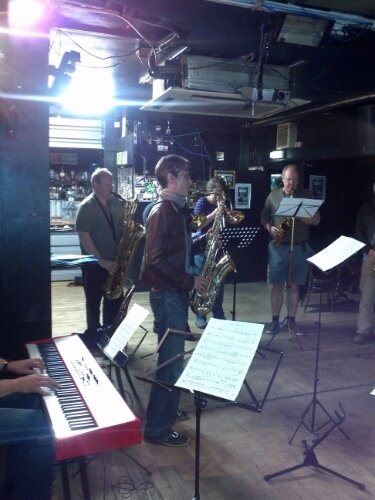
Many thanks to Roland Perrin for an enjoyable session in which we covered:
“Descarga Ardendo” by Roland Perrin
“Carioquinha” By Roland Perrin
The session started with a great composition penned by Roland “Descarga Ardendo” (Burning Discharge?) which had written sections interspersed with open ended ones of improvisation performed over a great groove that alternated between Csus7 and C7. Everyone got a good bit of soloing over this one.
The second Roland Perrin composition “Carioquinha” was a lot trickier with a non-stop stream of notes testing the sight reading skills of the front-line (which seemed to cope admirably).
Thanks again to Roland for bringing along two greatly enjoyable compositions and educating us in the way of the clave.
Many thanks to Colin Holdom for stepping in and providing an educating session in which we covered:
“Joy Spring” by Clifford Brown
“And What If I Don’t” by Herbie Hancock
With a view to handling ii-V-I’s, a key skill in tackling the great majority of jazz standards, Colin introduced the Dorian minor mode – the mode based on the second degree of the major scale. We played through a few exercises based on the Dorian to see how it could be applied to a ii-V-I. Heady with new found knowledge we played the fantastic if tricky “Joy Spring” composition that contains many ii-V-I’s and which also modulates in various ways: down a tone, up a semi-tone, down a semi-tone, etc. We all had the chance to improvise over several choruses at various tempi during the course of the pre-lunch session. To make us a bit more familiar with the tune, Colin made us play only the roots so that we could feel the underlying structure a process that should be applied to all tunes that we intend to learn.
After the break, “And What If I Don’t” a great bluesy feeling composition by Herbie Hancock with a rhythm changes bridge was also tackled.
Many thanks to Colin for stepping in at short notice to cover for a tutor that could not be present.
Many thanks to Roger Beaujolais to an educational session in which we covered:
“Lady Bird” by Tadd Dameron
“Half Nelson” by Miles Davis
This session involved a lot of playing over what was more or less the same chord sequence with Half Nelson being a contrafact on Lady Bird. Both are great tunes with interesting be-bop aspects in each.
Some time was spent on dealing with the unusual turn around in the last two bars that Lady Bird is famous for: CMaj7 EbMaj7 | AbMaj7 DbMaj7. Roger suggested applying a 1-2-3-5 digital pattern to each chord in turn and introduced us to a great practise technique of taking a 1-2-3-5 pattern through the cycle of 4ths C, F, Bb etc, first using a major chord and then a minor and pointing out that any pattern should be treated in the same way so that it becomes ingrained.
Many thanks to Mick Foster for an interesting session in which we covered
“The Saga of Harrison Crabfeathers” by Steve Kuhn
“Jumping at the Woodside” by Count Basie
The first part of the session was taken with an investigation of the Steve Kuhn composition “The Saga of Harrison Crabfeathers.” In this we were shown the various modes used in the piece. Mick kindly supplied some worksheets for further study here:
For the second part of the session, Mick whipped out his Bass Sax (if it’s possible to do so with such a beast) and took us through “Jumping at the Woodside” making us improvise rythmically with only restricted chord tones: Root and 5th, triads and then chord tones to the 7th. He pointed out how restricting to the chord tones can make the improvisations sound less modern.
Many thanks to the amazing Sheryl Bailey for this week’s session in which we covered the following compositions:
“Sonnymoon for Two” by Sonny Rollins.
“All The Things You Are” by Jerome Kern.
The session started with a run through of “Sonnymoon for Two” with the co-op members taking a couple of choruses each. Here’s a clip towards the end with Derek’s solo on vibes (who knew? we thought he was merely a great drummer) followed by Sheryl closing the song:
During our solos Sheryl had been listening and picked up on some good playing especially by Giulio and Mickey and also spotted areas where there could be improvements (surely not!). Here are a few of her observations, hints and tips; plenty to consider:
After a short break, we turned to “All The Things You Are”. Here we are again, towards the end with Giulio on bass followed by Derek on vibes and then finally Sheryl closing it down:
Sheryl applied tritone subs at every point possible to give the following changes:
To get these changes consider a ii-V-I in C major
| Dm7 | G7 | CMaj7 | // |
We can apply a tritone Db7 substitution for the G7 to give
| Dm7 | Db7 | CMaj7 | // |
then whenever we see a ii chord we can add its related V and wherever we see a V chord we can add its related ii to convert them to a ii-V, giving the following:
| Dm7 G7 | Abm7 Db7 | CMaj7 | // |
Here’s Sheryl plugging a ii-V lick into the resulting changes:
If members of the Cambridge Jazz Co-op should take anything away from this session it would be the idea that “I don’t need to comp“:
Well, that was epic. Many thanks to Sheryl for coming to Cambridge and being so generous with her time and comments to the members of the Cambridge Jazz Co-op.
Many thanks to Pete Lemer for an interesting session in which we covered:
“Hadouk” by Didier Malherbe
“Nutsville” by Horace Silver
“Hadouk” was a slow composition with Middle Eastern flavour to it and had a slow melody played over a relatively simple arpeggiated background supplied by the guitars.
“Nutsville” was a much faster workout on the Horace Silver classic.
Many thanks to Adam for a great blowing session in which we played:
“Passion Fruit” by Ronnie Cuber
“Arroz con Pollo” by Ronnie Cuber
“Tones” by Adam Amor
The first part of the session saw the co-op members playing two originals by Ronnie Cuber, the great baritone saxophonist; “Passion Fruit” was described by Adam as “Summertime meets Work song” and is a brisk Latin number. “Arroz con Pollo” continued in a similar vein, it being a 12 bar composition with plenty of descending ii-Vs in the middle eight bars.
The afternoon session saw the township styled “Tones” penned by Adam himself being given the co-op treatment.
Many thanks to Michele Gori who gave us an in depth tutorial on the blues, including but not limited to, the basic form, common jazz blues extensions, altered chords and tri-tone substitutions.


![IMG_20140215_124732211[1]](http://www.cambridgejazzcoop.org.uk/wordpress/wp-content/uploads/2014/02/IMG_20140215_1247322111.jpg)